Home › Notes › Solar terms › Dongji
Dongji 2026: winter solstice time, Jung-dongji and red bean porridge
Dongji 2026 falls on 22 December at 05:50 KST. The Korean lunar date is month 11, day 14: it is Jung-dongji, the middle part of the month (days 11–20). We checked KASI's monthly astronomy calendar against the engine's lunar conversion.
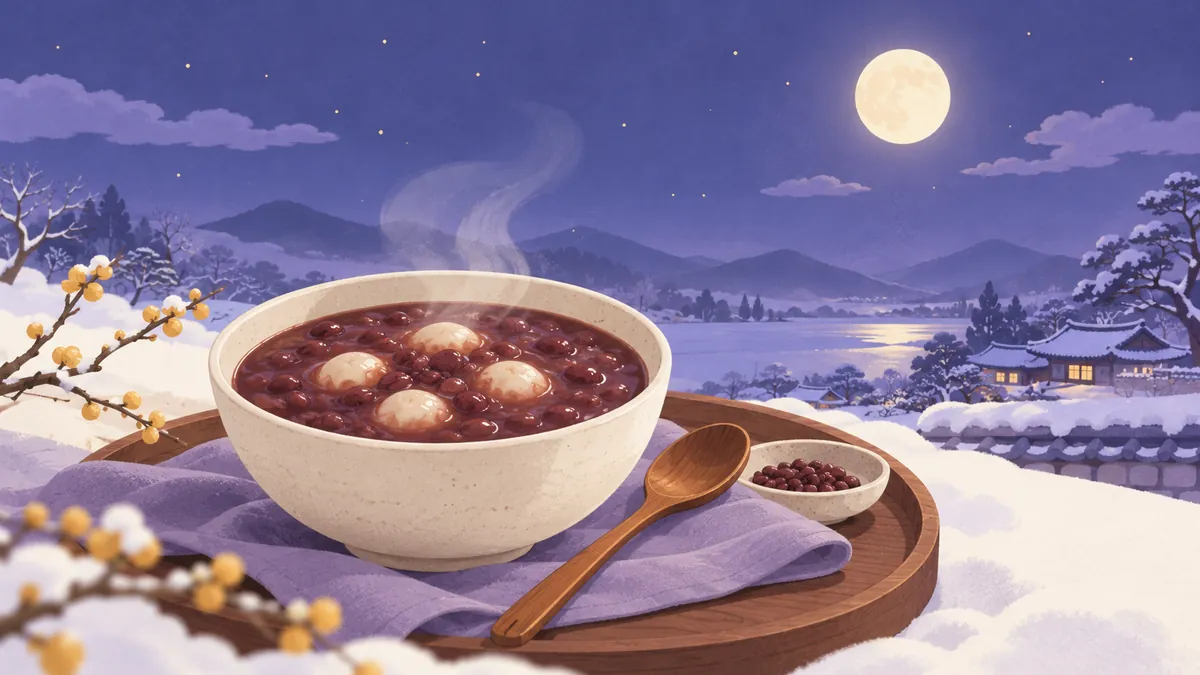
Dongji is the moment the sun sits lowest in the southern sky. After this day, the days start getting longer again. Among the 24 solar terms it's a gi (氣), and it marks the midpoint of the Rat month (子月).
In this article 7 topics
How short is the day on Dongji?
For Seoul on 22 December 2026, the listed sunrise is 07:43 and sunset 17:18. Subtracting these minute-rounded times gives 9 hours 35 minutes of daylight. This is seasonal planning information, not a diagnosis of anyone's health or mood.
Dongji times by year
Dongji falls on December 21 or 22. Its time shifts about six hours later each year, then jumps back a day in a leap year.
| Year | Date | Solar-term entry time | Lunar date | Category |
|---|---|---|---|---|
| 2026 | Dec 22 (Tue) | 05:50 | 11/14 | Jung-dongji |
| 2027 | Dec 22 (Wed) | 11:42 | 11/25 | No-dongji |
| 2028 | December 21 (Thu) | 17:19 | November 6 | Ae-dongji |
| 2029 | Dec 21 (Fri) | 23:14 | 11/17 | Jung-dongji |
| 2030 | Dec 22 (Sun) | 05:09 | 11/28 | No-dongji |
What are Ae-dongji, Jung-dongji and No-dongji?
Dongji 2026 falls on 22 December at 05:50 KST. The Korean lunar date is month 11, day 14: it is Jung-dongji, the middle part of the month (days 11–20). We checked KASI's monthly astronomy calendar against the engine's lunar conversion.
Jung-dongji is an occasion to share patjuk, red bean porridge with small rice balls. Some Ae-dongji traditions use red bean rice cake instead. These are household and regional customs, not evidence that a food controls a child's fate.
They're names based on where in the 11th lunar month Dongji falls. Whether people cook patjuk or make rice cake depends on it.
The same Dongji gets a different name each year because the lunar and Gregorian calendars move separately. Dongji is set by the sun, so it's fixed in the Gregorian calendar, but its lunar date shifts by about ten days from year to year. So in some years it lands early in the 11th lunar month, and in others, late.
Does the Saju change at Dongji?
No. Dongji is a gi (氣), so it doesn't turn the month. The Rat month (子月) begins not at Dongji but at Daeseol (大雪, Major Snow; December 6–7) and runs until the next Sohan (小寒, Minor Cold; January 5–6). Dongji is simply the midpoint of that Rat month.
A lot of people get confused here. Having heard that “the new year comes after Dongji,” some count anyone born after December 22 as belonging to the next year, but in Saju the year changes at Ipchun (立春, Start of Spring). I've explained the difference between jeol and gi in The 24 solar terms: a complete guide.
So why was Dongji called “Little Seollal”?
Because in the old days Dongji really was seen as the start of the year. It was called Ase (亞歲), meaning “second only to Seollal,” and that's where the saying “You have to eat Dongji patjuk to turn a year older” comes from.
It's not a baseless idea. Dongji is seen as iryang-sisaeng (一陽始生) — the moment when, with yin filled to the brim, the first trace of yang is born. Physically, too, the days start getting longer from this day. People long ago also sensed it as the point where things hit bottom and turn around.
The darkest day is not the end but the bottom — that's the feeling behind treating Dongji as a new year.
What's good to do on Dongji?
It's not a day to make a big fuss over. Still, it's a good moment to fold up the year and sketch out the next one.
- Sum up the year in one lineWrite down just one thing you remember. It doesn't matter whether it went well or not.
- Check your schedule for the first quarter of next yearIf something big is coming early in the year, it's easier to set the date now. How to choose a good day should help.
- A bowl of patjuk or a slice of bean rice cakeRice cake if it's an Ae-dongji year, porridge if not. It's a small rule, but keeping it feels nice.
After Dongji, where is my rhythm heading?
Mutal Unnie offers a Yearly report that previews the tone of each of next year's twelve months.
Get the app for iPhone & AndroidFAQ
When is Dongji 2026, and which type is it?
Dongji 2026 falls on 22 December at 05:50 KST. The Korean lunar date is month 11, day 14: it is Jung-dongji, the middle part of the month (days 11–20). We checked KASI's monthly astronomy calendar against the engine's lunar conversion.
Why don't people eat patjuk on Ae-dongji?
When Dongji falls on days 1–10 of the 11th lunar month, it's an Ae-dongji, and instead of patjuk (red bean porridge) people make patsirutteok (steamed rice cake layered with red beans). It comes from a folk belief that the porridge isn't good for children. In 2028, Dongji falls on the 6th day of the 11th lunar month, so it's an Ae-dongji.
Does the Saju change at Dongji?
No. Dongji is not a jeol but a gi, so it doesn't change the month pillar. The Rat month begins at Daeseol. The Saju year changes at Ipchun.
How much daylight is there in Seoul on Dongji 2026?
For Seoul on 22 December 2026, the listed sunrise is 07:43 and sunset 17:18. Subtracting these minute-rounded times gives 9 hours 35 minutes of daylight. This is seasonal planning information, not a diagnosis of anyone's health or mood.